After studying chapters of EMI(electro magnetic induction) and SEMI-CONDUCTOR DEVICES(mainly transistor) made me more interested in the construction of the electric guitar.
So every one of you have must have heard of it and seen it at some point of time in you're life,and also an acoustic guitar.Although the sound created by both of them is by the means of plucking strings,but once the strings are plucked they both have completely different means to produce sound.
so the strings when plucked can only be displaced by small a small amount which would not be enough to hear any sound, to erradicate this problem acoustic guitars have a sound box or in more scientific terms a resonant cavity.the fretboard(bridge) transmits these vibrations to the soundboard and thus the sound box beneath it(its the hollow cavity u) and it displaces a larger volume of air to create a sound larger than the strings alone making the sound audible.
While in case of electric guitars Faraday's law of induction is used. Pickups are used for this purpose, but before that,those who don't know about Faraday's law...
Faraday's Law of Induction. It states that a changing magnetic field causes an electric field to be set up in a nearby wire, causing a current to flow if the wire is part of a closed circuit (a loop of wire for example).
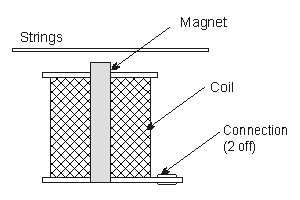
The basic construction of a pickup is a oil wrapped over a magnet.
this is a basic construction of a pickup.The guitar string is made up of nickel and steel(ie. iron and carbon) making it ferromagnetic,thus it is attracted by the magnet. the magnet creates a north pole and a south pole in the portion of the string just above it.When the guitarist plucks the string he disturbs the magnetic feild produced by the magnet, which is also associated with the coil thus inducing current in the coil.As the string is made to osscilate above the coil the induced current also changes its direction with the frequency of the oscilation. the wires of the coil go into the amplifier thus relaying the frequency of oscillations to the amp and speaker(more about amplifiers in the next post,hat is the more interesting part).
So to understand pickups better it is necessary to understand how strings vibrate,I'll not go into the depths of the topic, only the basic that will be needed to improvise you're understanding of pickups.
oscillations in a guitar string are actually stationary waves on a string connected at both ends(it has no free end).stationary waves or standing waves are those which remain in constant position.
A STANDING WAVE
the red dotes represent nodes-points of minimum displacement
the points of maximum displacement between them are called antinodes
Important: The string does not move at a node. that means you can touch the string exactly at the node and it keeps on making sound!
this string vibrates on many frequencies but all of them are the integral multiples of the fundamental frequencies(1x, 2x, 3x, etc.). to know what is the fundamental frequency and all go read an article on stationary waves but not knowing that will not hinder you're understanding here.You cannot actually see nodes/antinodes forming on a vibrating guitar string but you can see there are some skinny and fat points,the fat points must correspond to antinode and the skinny ones to nodes.the different frequencies on which the string vibrates are known as harmonics or overtones.
A PICKUP,the red lines depict the magnetic feild lines not the coil(which is not shown here).
A GUITAR STRING VIBRATING ON DIFFERENT HARMONICS
the pickup can only detect movements near it,in the 1st and the 3rd case the pickup is situated near the antinode but in 2nd case it will not hear any sound as it is below a node.
in real life when a string is plucked it does not vibrate at a single frequency rather than on many freqencies the fundamental, 1st overtone ,2nd overtone....
the filtering of sound is also done by the pickup as it only picks up the tones which have a antinode near it and ignores the ones having nodes in the vicinity of it.
even overtones will have nodes near the pickup while odd ones will have antinode,so every odd overtone will go to the amp while every even overtone will make it silent.
A STRING VIBRATING ON MANY OVERTONES AT THE SAME TIME
two pickups are further used to gain more control over the sound of the guitar as more efficient filtering can be done.in case of two pickups the string might be moving away from one pickup and towards another pickup and many cases like this will be possible.this causes the signals produced by the pickups to add/cancel together.so as you can see in this manner the 7th overtone will be strong while the 10th overtone will be reduced in volume.as u can easily see the distance between the pickups will affect the filtering widely but there are two more levels of complexities in filtering ie pickup bridge distance and the other being the distance between the pickup and the point where the string is plucked.For every string at every fret there is a pair of such filters which determine how does the string sound.
there is another aspect to plucking of string ie the way you pluck it.A string when plucked does not nessearily oscillate in the same plane.see the fig. below




The picture shows a string vibrating over a pickup, viewed end-on. It's even more because when you pluck a string, the string does not vibrate in a plane (red line), but in any number of planes, or circles (green), or ellipses (white). In fact, the ellipses can even rotate around their center as the note decays. .When we add to that all the variations on pickup construction (magnet type, magnet position, magnet strength, wire size, number of turns on the coil, pickup position in the guitar), it's apparent that billions of sounds are available.
The god of guitar,none other than JIMI HENDRIX exploited this to his benefit, to gain more control over his music he many-a-times changed the number of coils of the pickup. In this manner he could control the amount of emf induced in the coils and thus changing the sensitivity to string oscillations.
if you liked this post be sure to be back cause there will be some more about pickups and amplifiers.


0 comments